The JISC funded RePosit project (RePosit: positing a new kind of repository deposit)http://jiscreposit.blogspot.com/ is investigating the effectiveness of a deposit tool in central research management system - Symplectic Elements - with a local institutional repository (WRRO). Many researchers at the University of Leeds interact with Symplectic on a regular basis and Symplectic acts as the university's central publication database. Shortly, depositors from Leeds will be able to upload full texts of their works to Symplectic; the metadata and any attached files will be immediately posted to WRRO for review. RePosit aims to create useful training materials / events to let depositors know about the new deposit route and obtain their feedback about it. We hope to see a rise in content over the course of the project and will be monitoring this closely.
Although University of Leeds is the project lead, the findings will be relevant for University of Sheffield (as a Symplectic site) and for the University of York. University of York is rolling out the PURE Campus Research Information System later this year. The outcomes from RePosit will be immediately relevant for York; it is envisaged PURE will become the main locus of deposit for WRRO content deposited by York researchers. A connector between the PURE system and WRRO is currently under development.
If you have any questions about the RePosit project, please email eprints@whiterose.ac.uk
Friday, 3 September 2010

Tuesday, 29 June 2010
Royal Society policy supports open access self-archiving
The Royal Society no longer requires authors to wait 12 months before making their papers freely available in White Rose Research Online; Royal Society authors can now make their work available immediately. The final peer reviewed manuscript, as accepted for publication, can be deposited. Here are the Royal Society's Open Access options.
Uploading your accepted manuscript to White Rose Research Online is supported by many publishers - the RoMEO service lists hundreds of publishers which allow the final peer reviewed manuscript of your work to be made openly available. Some have an embargo period, some, like the Royal Society, Elsevier and Springer, do not have an embargo period. Most publishers don't allow open posting of the final, as published, PDF of a work with the publisher formatting etc - though some do.
Friday, 26 March 2010
Latest statistics for WRRO
Usage of WRRO continues to rise. Data from Google Analytics shows 159,590 visits from 141,734 people from 203 countries/territories. Our most popular access route continues to be Google, generating 74% of our traffic. About 10% of users find us through a "referring site" - in other words, another web site linking to a page in WRRO. Over time, the % of our users who find us via linking sites is increasing. The most popular linking site is the University of Leeds Philosophy Department - e.g. Ross Cameron's web page. We also get accesses via wikipedia where White Rose papers have been linked from wikipedia articles. For example, this article on the Oldhams Limited cotton manufacturing companies links to Proctor & Toms' paper Procter, Stephen and Toms, Steven (2000) Growth, Profits and Technological Choice: The Case of the Lancashire Cotton Textile Industry, 1880-1914. Journal of Industrial History, 3 (1). pp. 54-72.
The top ten most popular terms typed into search engines which brought users to WRRO are:
"climate change"
"clinical decision making"
"decision making in nursing"
"clinical decision making in nursing"
"pornographic art"
"action research model"
"primeval games"
"permanent magnet generator"
"white rose research online"
"white rose repository"
The top ten most popular terms typed into search engines which brought users to WRRO are:
"climate change"
"clinical decision making"
"decision making in nursing"
"clinical decision making in nursing"
"pornographic art"
"action research model"
"primeval games"
"permanent magnet generator"
"white rose research online"
"white rose repository"
Wednesday, 6 January 2010
Universities UK Recommend all REF outputs should be open access
HEFCE's consultation on proposals for the Research Excellence Framework ended in December 09. The Universities UK consultation response suggests that, though not addressed in the REF proposals, it would be beneficial if all REF outputs were made openly available. The full text of the UUK response is available from the UUK website. On open access, the document states "UUK supports the move toward ‘open access’ of research outputs and, although not mentioned in the consultation, would encourage the REF guidance to require that all submitted outputs are available through some form of open access mechanism. This would build on good research and information management practice. Work currently being undertaken by JISC and other stakeholders can support this process."
Of course, the White Rose Research Online system aims to hold research outputs beyond those to be submitted for the REF. Whatever HEFCE's response to the UUK suggestion, it's already possible for White Rose researchers to do what UUK recommends - at least, for a significant proportion of research outputs. And, as deposit into WRRO may well boost the impact of your research outputs, there's little to lose - but potentially much to gain - by depositing.
Of course, the White Rose Research Online system aims to hold research outputs beyond those to be submitted for the REF. Whatever HEFCE's response to the UUK suggestion, it's already possible for White Rose researchers to do what UUK recommends - at least, for a significant proportion of research outputs. And, as deposit into WRRO may well boost the impact of your research outputs, there's little to lose - but potentially much to gain - by depositing.
Thursday, 3 December 2009
Inaugural White Rose Research Support Forum!
Library staff from Leeds, Sheffield and York met in Leeds on the 27th Nov to discuss how we provide research support for researchers at out institutions. Attendees indicated they were particularly keen to learn more about bibliometrics - and a presentation on this topic plus a hands-on exercise provided a key part of the day. We considered the implications of the Research Excellence Framework and other recent developments and drivers such as the Research Councils' Outputs and Outcomes Collection (the OOCS project). Deposit of research papers into our consortial open access repository, White Rose Research Online, was discussed. We also looked at the emerging digital curation landscape which will be needed to manage a whole range of research outputs including datasets and audio-visual materials.
The presentations from this varied and interesting day are available online from the White Rose Research Support Forum site. We hope this will not be a one-off event; the White Rose Advocacy Group and Steering Group are considering when and where to organise a follow up. This forum is valuable for sharing ideas and good practice across the three library services but also for meeting other university colleagues directly involved in research or research support.
The presentations from this varied and interesting day are available online from the White Rose Research Support Forum site. We hope this will not be a one-off event; the White Rose Advocacy Group and Steering Group are considering when and where to organise a follow up. This forum is valuable for sharing ideas and good practice across the three library services but also for meeting other university colleagues directly involved in research or research support.
Monday, 2 November 2009
RSP Competition for Open Access week

Open access week has become an annual, international event - http://www.openaccessweek.org/. The event - or rather, a series of events, announcements, competitions etc. - aims to highlight the importance of open access to research outputs and increase awareness and understanding of the value of open access to the academic community and beyond.
The Repositores Support Project invited all UK repositories to tally how many full text, open access papers were added during open access week. White Rose Research Online - specifically, the Sheffield section of White Rose Research Online - were the winning service. We uploaded a variety of full text journal papers and a series of Working Papers from the Department of Economics.
Access statistics from Google Analytics for the five days of open access week (Oct 19th - Oct 23rd) show 3,492 visitors from 103 countries and territories. Top keyword search for the week was "climate change".
Don't miss out! Ensure your research is uploaded to your prize-winning local repository.
Monday, 5 October 2009
Improvements to import using DOI
Eprints has an import via DOI plugin. This import can be used to create single records - or multiple DOIs can be included and imported. The data is imported into the repository from the CrossRef service.
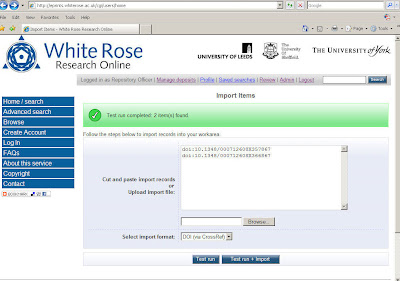
Once logged in to WRRO, go to the Manage Deposits screen, and click on the Import Items button. Then enter your DOIs as below, ensuring you have selected DOI (via Cross Ref) as your import format.
Until recently, for multi-author works, only the name of the first author was imported into the repository. However, functionality has recently improved and all authors are now being imported - which makes using DOI a much more attractive import option. It's still not perfect because the formatting of the author names is quite varied (some are all upper case, others not, some have expanded forenames, others have initials). This simply reflects the variation in data supplied by the journal publishers. The main bit of information still missing from the import is full pagination: generally you get the article start page but not the end page. Can save quite a bit of time - particularly if importing several records.
Once logged in to WRRO, go to the Manage Deposits screen, and click on the Import Items button. Then enter your DOIs as below, ensuring you have selected DOI (via Cross Ref) as your import format.

Until recently, for multi-author works, only the name of the first author was imported into the repository. However, functionality has recently improved and all authors are now being imported - which makes using DOI a much more attractive import option. It's still not perfect because the formatting of the author names is quite varied (some are all upper case, others not, some have expanded forenames, others have initials). This simply reflects the variation in data supplied by the journal publishers. The main bit of information still missing from the import is full pagination: generally you get the article start page but not the end page. Can save quite a bit of time - particularly if importing several records.
Subscribe to:
Posts (Atom)